Lignin: From Wood Waste to Eco-Friendly Herbicide Nanoparticle Innovation
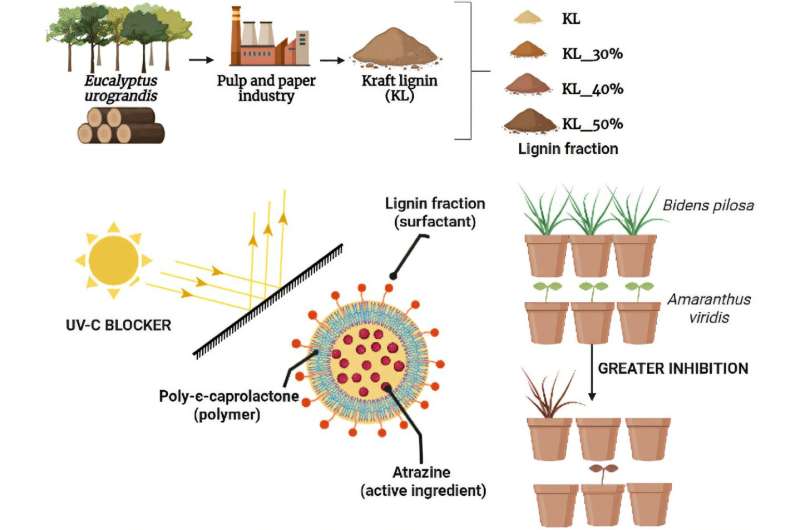
In a move toward sustainable agriculture, scientists in Brazil have found a new use for lignin the natural polymer that strengthens plant cell walls as a key ingredient to enhance the stability and effectiveness of herbicide-loaded nanoparticles. This discovery paves the way for greener biopolymer-based technologies, including applications in biotechnology. A collaborative team from São Paulo State University (UNESP), the State University of Campinas (UNICAMP), and the Federal University of São Carlos (UFSCar) investigated how lignin fractions extracted from Eucalyptus urograndis wood could be used to develop more stable herbicide nanoparticles. The lignin was obtained through an environmentally friendly acetic acid–based process, producing multiple fractions with distinct structural and chemical properties. These variations were found to influence nanoparticle formation, UV protection, and controlled release behavior. When combined with atrazine-based herbicide nanoparticles, the selected lignin fraction significantly improved stability and controlled herbicide release, showing higher weed control efficiency against Bidens Pilosa (black jack) and Amaranthus viridis (green pigweed).
This study, published in ACS Sustainable Chemistry & Engineering (October 2025) and featured on Phys.org (October 29, 2025), highlights how lignin traditionally regarded as a waste product of the pulp and paper industry can serve as a sustainable component in agrochemical formulations. This topic intersects biotechnology, nanotechnology, and green chemistry. The principle of using renewable biomass such as lignin to create functional nanoparticles can also inspire innovations in food biotechnology, such as nutrient delivery systems, bioactive compound encapsulation, and sustainable packaging materials. The discovery reinforces biotechnology’s vital role in driving sustainable innovations across sectors from agriculture to food industries. By harnessing plant-based materials like lignin, researchers are building a greener and smarter future for global bioeconomy.
Sumber:
Phys.org – “Lignin increases the stability and effectiveness of herbicide nanoparticles, study shows” (29 Oktober 2025).
Artikel berdasarkan hasil penelitian yang diterbitkan di ACS Sustainable Chemistry & Engineering oleh tim dari UNESP, UNICAMP, dan UFSCar.
Writer: Jauharotus Shobahah, S.Si., M.Sc.
