The Science of Speed, Stability, and Separation: A Biotech Student (Basic Chemistry Experiment)
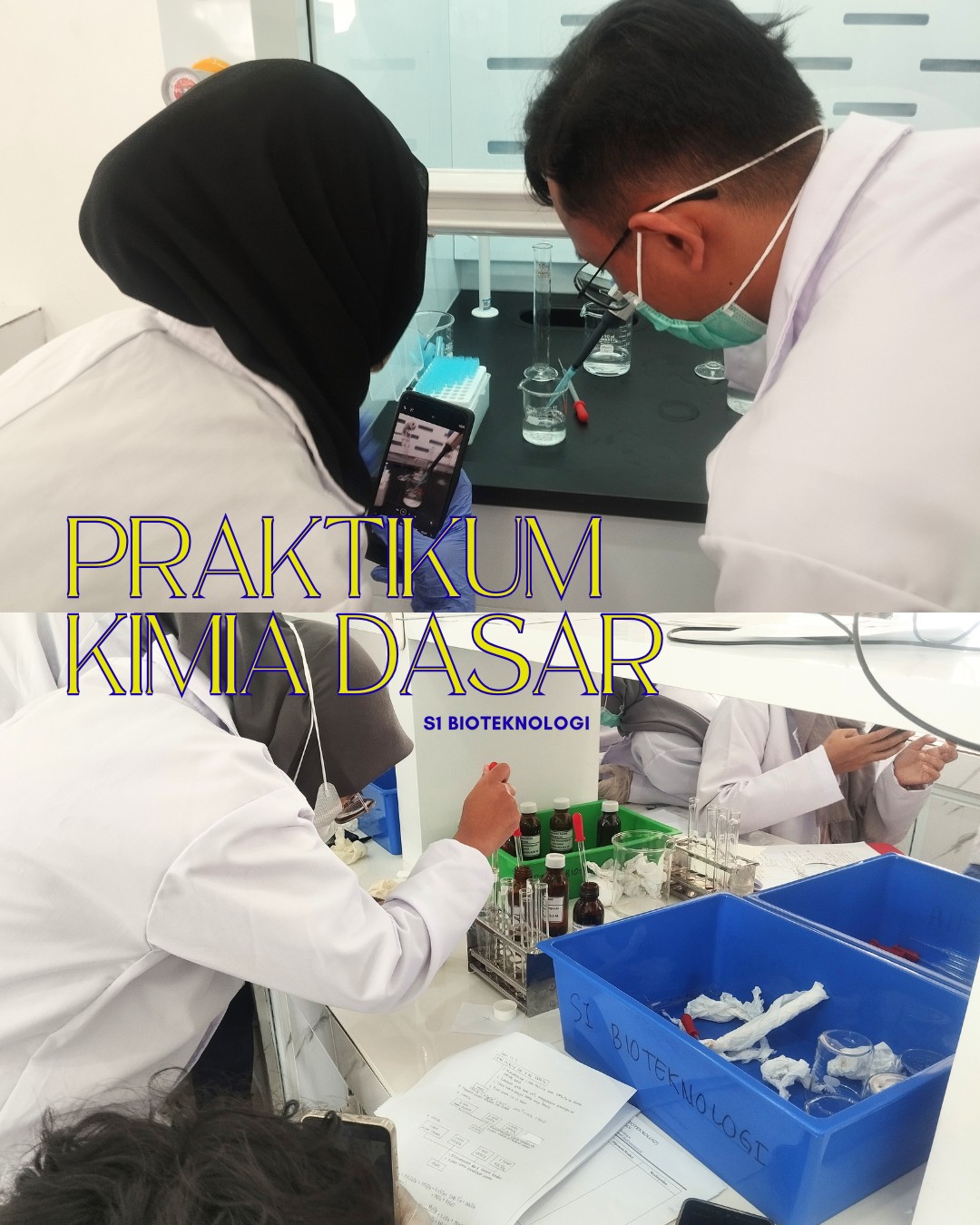
It wasn't just another day in the lab for the undegraduate students
at UNESA's Faculty of Food Security. The recent
Basic Chemistry practicum was a hands-on immersion into the core principles
that power real-world biological innovation. This wasn't just about mixing liquids; it was about
learning to control the very language of life.
Mastering the 'Guardians' of Biology
The first
challenge: buffer preparation. In the delicate world of
biotechnology, stability is everything. A tiny shift in pH can destroy an
enzyme, ruin a cell culture, or invalidate an entire experiment. Our students
meticulously crafted these "chemical guardians," learning the precision
required to maintain the perfect environment for biological discovery. It’s the
foundational skill that separates a good scientist from a great one.
The Chemical Racetrack: Unveiling the Invisible
Next, the lab
transformed into a forensic investigation. Using Thin-Layer
Chromatography (TLC), students became chemical detectives. They applied
their mixtures and watched as a "racetrack" on a silica plate
separated the invisible. This powerful technique, which reveals the individual
components hidden within a complex sample, is a cornerstone of biotechnology.
It’s how we find new medicines, check for food purity, and understand complex
biological systems.
Controlling the Clock: The 'Fast and Furious' of Reactions
The session
culminated in a thrilling exploration of reaction rates. Chemistry
isn't static; it's a dynamic, high-speed process. Students didn't just watch
reactions they learned to control them. By manipulating
conditions, they learned how to speed up, slow down, and manage the processes
that create new products. This knowledge is vital for designing efficient
biofuels, developing life-saving pharmaceuticals, or ensuring the safety and
longevity of our food supply.
This Basic
Chemistry practicum is far more than a course requirement. It is the crucible
where our S1 Biotechnology students forge theory into skill. They left the lab
not just with data, but with a deeper understanding of how to analyze,
stabilize, and control the building blocks of life preparing them to
solve the future's biggest challenges in food security and beyond.
Writer: Shinta
Wulansari, M.Sc.
